
Lidschluss-Reflex beim Laserpointer
About points...
We associate a certain number of points with each exercise.
When you click an exercise into a collection, this number will be taken as points for the exercise, kind of "by default".
But once the exercise is on the collection, you can edit the number of points for the exercise in the collection independently, without any effect on "points by default" as represented by the number here.
That being said... How many "default points" should you associate with an exercise upon creation?
As with difficulty, there is no straight forward and generally accepted way.
But as a guideline, we tend to give as many points by default as there are mathematical steps to do in the exercise.
Again, very vague... But the number should kind of represent the "work" required.
When you click an exercise into a collection, this number will be taken as points for the exercise, kind of "by default".
But once the exercise is on the collection, you can edit the number of points for the exercise in the collection independently, without any effect on "points by default" as represented by the number here.
That being said... How many "default points" should you associate with an exercise upon creation?
As with difficulty, there is no straight forward and generally accepted way.
But as a guideline, we tend to give as many points by default as there are mathematical steps to do in the exercise.
Again, very vague... But the number should kind of represent the "work" required.
About difficulty...
We associate a certain difficulty with each exercise.
When you click an exercise into a collection, this number will be taken as difficulty for the exercise, kind of "by default".
But once the exercise is on the collection, you can edit its difficulty in the collection independently, without any effect on the "difficulty by default" here.
Why we use chess pieces? Well... we like chess, we like playing around with \(\LaTeX\)-fonts, we wanted symbols that need less space than six stars in a table-column... But in your layouts, you are of course free to indicate the difficulty of the exercise the way you want.
That being said... How "difficult" is an exercise? It depends on many factors, like what was being taught etc.
In physics exercises, we try to follow this pattern:
Level 1 - One formula (one you would find in a reference book) is enough to solve the exercise. Example exercise
Level 2 - Two formulas are needed, it's possible to compute an "in-between" solution, i.e. no algebraic equation needed. Example exercise
Level 3 - "Chain-computations" like on level 2, but 3+ calculations. Still, no equations, i.e. you are not forced to solve it in an algebraic manner. Example exercise
Level 4 - Exercise needs to be solved by algebraic equations, not possible to calculate numerical "in-between" results. Example exercise
Level 5 -
Level 6 -
When you click an exercise into a collection, this number will be taken as difficulty for the exercise, kind of "by default".
But once the exercise is on the collection, you can edit its difficulty in the collection independently, without any effect on the "difficulty by default" here.
Why we use chess pieces? Well... we like chess, we like playing around with \(\LaTeX\)-fonts, we wanted symbols that need less space than six stars in a table-column... But in your layouts, you are of course free to indicate the difficulty of the exercise the way you want.
That being said... How "difficult" is an exercise? It depends on many factors, like what was being taught etc.
In physics exercises, we try to follow this pattern:
Level 1 - One formula (one you would find in a reference book) is enough to solve the exercise. Example exercise
Level 2 - Two formulas are needed, it's possible to compute an "in-between" solution, i.e. no algebraic equation needed. Example exercise
Level 3 - "Chain-computations" like on level 2, but 3+ calculations. Still, no equations, i.e. you are not forced to solve it in an algebraic manner. Example exercise
Level 4 - Exercise needs to be solved by algebraic equations, not possible to calculate numerical "in-between" results. Example exercise
Level 5 -
Level 6 -
Question
Solution
Short
Video
\(\LaTeX\)
Need help? Yes, please!
The following quantities appear in the problem:
Zeit \(t\) / Arbeit \(W\) / Energie \(E\) / Leistung \(P, \Phi\) / Geschwindigkeit \(v\) / Fläche \(A\) / Frequenz \(f\) / Anzahl \(N\) / Wellenlänge \(\lambda\) / Strahlungsintensität \(I\) /
The following formulas must be used to solve the exercise:
\(P = \dfrac{E}{t} = \dfrac{W}{t} = \dfrac{Q}{t} \quad \) \(E=hf \quad \) \(I = \dfrac{P}{A} \quad \) \(E = N \cdot E_1 \quad \) \(c = \lambda \cdot f \quad \)
No explanation / solution video to this exercise has yet been created.
Visit our YouTube-Channel to see solutions to other exercises.
Don't forget to subscribe to our channel, like the videos and leave comments!
Visit our YouTube-Channel to see solutions to other exercises.
Don't forget to subscribe to our channel, like the videos and leave comments!
Exercise:
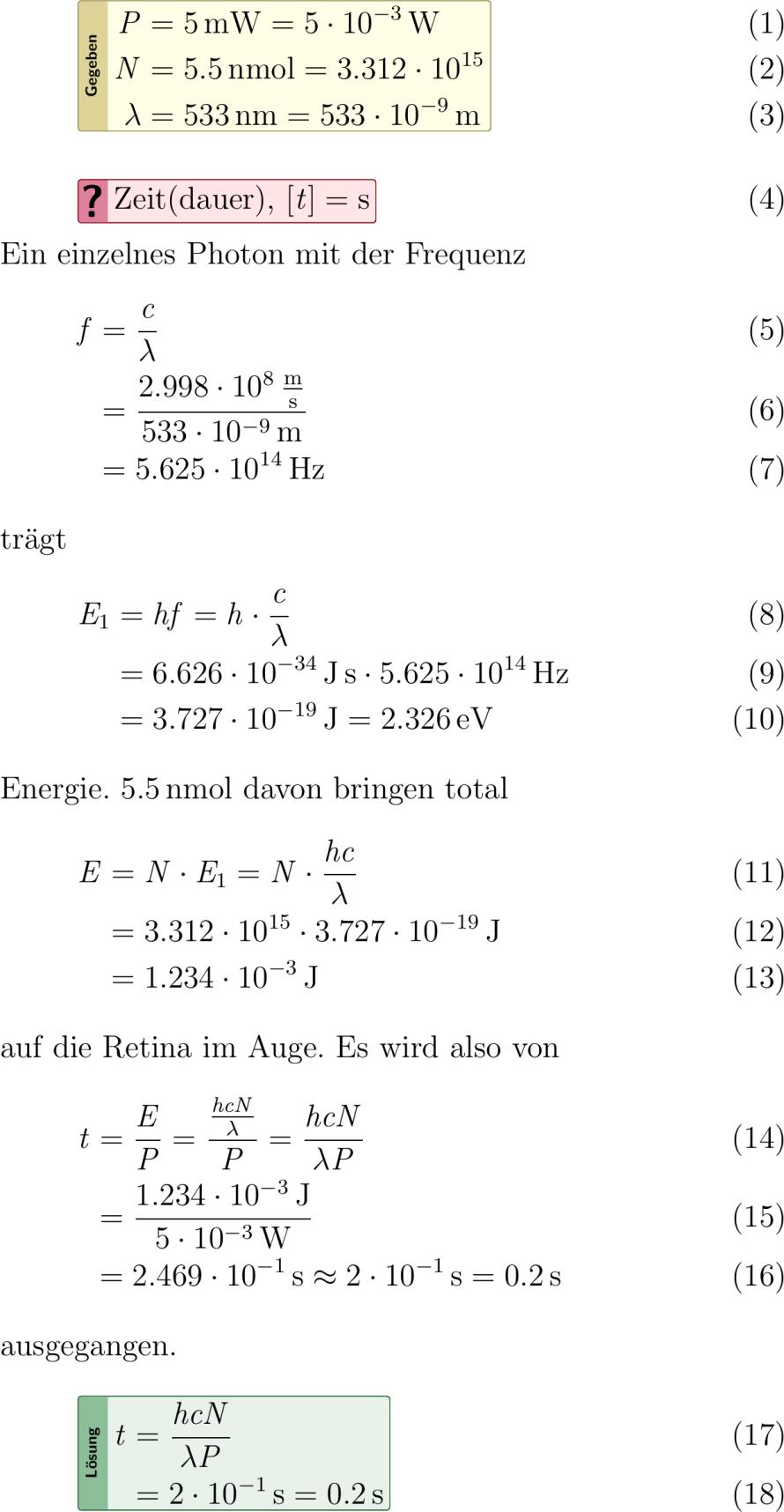
Ein Laserpoer der Klasse darf maximal PO abgeben damit der Lidschluss-Reflex enquoteBlinzeln ausreicht um das Auge vor Schäden zu bewahren. Treffen nämlich mehr als NO der Photonen aus einem roten Laser lamO auf das Auge dann herlassen sie Verbrennungen auf der Retina ein sogenanntes Skotom. Wie lange rechnet man also dass es dauert bis das Auge aufgrund dieses Reflexes geschlossen ist?
Solution:
Geg P PO P N NO N lambda lamO lam GesZeitdauertsis Ein einzelnes Photon mit der Frequenz f fracclambda fracncclam f trägt E_ hf h fracclambda nch f Ee EeeV Energie. NO davon bringen total E N E_ N frachclambda N fracnch ncclam E auf die Retina im Auge. Es wird also von t fracEP fracfrachcNlambdaP frachcNlambda P fracnch ncc Nlam P t approx tS tP ausgegangen. t frachcNlambda P tS tP
Ein Laserpoer der Klasse darf maximal PO abgeben damit der Lidschluss-Reflex enquoteBlinzeln ausreicht um das Auge vor Schäden zu bewahren. Treffen nämlich mehr als NO der Photonen aus einem roten Laser lamO auf das Auge dann herlassen sie Verbrennungen auf der Retina ein sogenanntes Skotom. Wie lange rechnet man also dass es dauert bis das Auge aufgrund dieses Reflexes geschlossen ist?
Solution:
Geg P PO P N NO N lambda lamO lam GesZeitdauertsis Ein einzelnes Photon mit der Frequenz f fracclambda fracncclam f trägt E_ hf h fracclambda nch f Ee EeeV Energie. NO davon bringen total E N E_ N frachclambda N fracnch ncclam E auf die Retina im Auge. Es wird also von t fracEP fracfrachcNlambdaP frachcNlambda P fracnch ncc Nlam P t approx tS tP ausgegangen. t frachcNlambda P tS tP
Meta Information
Exercise:
Ein Laserpoer der Klasse darf maximal PO abgeben damit der Lidschluss-Reflex enquoteBlinzeln ausreicht um das Auge vor Schäden zu bewahren. Treffen nämlich mehr als NO der Photonen aus einem roten Laser lamO auf das Auge dann herlassen sie Verbrennungen auf der Retina ein sogenanntes Skotom. Wie lange rechnet man also dass es dauert bis das Auge aufgrund dieses Reflexes geschlossen ist?
Solution:
Geg P PO P N NO N lambda lamO lam GesZeitdauertsis Ein einzelnes Photon mit der Frequenz f fracclambda fracncclam f trägt E_ hf h fracclambda nch f Ee EeeV Energie. NO davon bringen total E N E_ N frachclambda N fracnch ncclam E auf die Retina im Auge. Es wird also von t fracEP fracfrachcNlambdaP frachcNlambda P fracnch ncc Nlam P t approx tS tP ausgegangen. t frachcNlambda P tS tP
Ein Laserpoer der Klasse darf maximal PO abgeben damit der Lidschluss-Reflex enquoteBlinzeln ausreicht um das Auge vor Schäden zu bewahren. Treffen nämlich mehr als NO der Photonen aus einem roten Laser lamO auf das Auge dann herlassen sie Verbrennungen auf der Retina ein sogenanntes Skotom. Wie lange rechnet man also dass es dauert bis das Auge aufgrund dieses Reflexes geschlossen ist?
Solution:
Geg P PO P N NO N lambda lamO lam GesZeitdauertsis Ein einzelnes Photon mit der Frequenz f fracclambda fracncclam f trägt E_ hf h fracclambda nch f Ee EeeV Energie. NO davon bringen total E N E_ N frachclambda N fracnch ncclam E auf die Retina im Auge. Es wird also von t fracEP fracfrachcNlambdaP frachcNlambda P fracnch ncc Nlam P t approx tS tP ausgegangen. t frachcNlambda P tS tP
Contained in these collections
-
Anzahl Photonen in Lichtstrahl by TeXercises
| Title | Matched on |
|---|---|
| Solarium | tagsformula |
| Photonenenergie in Lichtstrahl | tagsformula |
| Photonen der Sonne | formula |
| Sehschwelle | formula |
| Tasse Wasser in Mikrowelle | formula |
Similar exercises (16)
| Title | Matched on |
|---|---|
| Solarium | tagsformula |
| Photonenenergie in Lichtstrahl | tagsformula |
| Photonen der Sonne | formula |
| Sehschwelle | formula |
| Tasse Wasser in Mikrowelle | formula |
| Masse von 1 mol Photonen | formula |
| Austrittsarbeit von Kalium | formula |
| Strahlungsleistung roter Leuchtdiode | formula |
| Maximale Bremsspannung für Silber | formula |
| Maximale Bremsspannung für Kalium | formula |
| Wellenlänge und Frequenz von Strahlung | formula |
| Energie von Photonen | formula |
| Beschleunigtes Elektron | formula |
| Energie von Photonen | tags |
| One joule of radiant energy | tags |
| Energy of a cell phone photon | tags |