
Dauer der Wurfbewegung
About points...
We associate a certain number of points with each exercise.
When you click an exercise into a collection, this number will be taken as points for the exercise, kind of "by default".
But once the exercise is on the collection, you can edit the number of points for the exercise in the collection independently, without any effect on "points by default" as represented by the number here.
That being said... How many "default points" should you associate with an exercise upon creation?
As with difficulty, there is no straight forward and generally accepted way.
But as a guideline, we tend to give as many points by default as there are mathematical steps to do in the exercise.
Again, very vague... But the number should kind of represent the "work" required.
When you click an exercise into a collection, this number will be taken as points for the exercise, kind of "by default".
But once the exercise is on the collection, you can edit the number of points for the exercise in the collection independently, without any effect on "points by default" as represented by the number here.
That being said... How many "default points" should you associate with an exercise upon creation?
As with difficulty, there is no straight forward and generally accepted way.
But as a guideline, we tend to give as many points by default as there are mathematical steps to do in the exercise.
Again, very vague... But the number should kind of represent the "work" required.
About difficulty...
We associate a certain difficulty with each exercise.
When you click an exercise into a collection, this number will be taken as difficulty for the exercise, kind of "by default".
But once the exercise is on the collection, you can edit its difficulty in the collection independently, without any effect on the "difficulty by default" here.
Why we use chess pieces? Well... we like chess, we like playing around with \(\LaTeX\)-fonts, we wanted symbols that need less space than six stars in a table-column... But in your layouts, you are of course free to indicate the difficulty of the exercise the way you want.
That being said... How "difficult" is an exercise? It depends on many factors, like what was being taught etc.
In physics exercises, we try to follow this pattern:
Level 1 - One formula (one you would find in a reference book) is enough to solve the exercise. Example exercise
Level 2 - Two formulas are needed, it's possible to compute an "in-between" solution, i.e. no algebraic equation needed. Example exercise
Level 3 - "Chain-computations" like on level 2, but 3+ calculations. Still, no equations, i.e. you are not forced to solve it in an algebraic manner. Example exercise
Level 4 - Exercise needs to be solved by algebraic equations, not possible to calculate numerical "in-between" results. Example exercise
Level 5 -
Level 6 -
When you click an exercise into a collection, this number will be taken as difficulty for the exercise, kind of "by default".
But once the exercise is on the collection, you can edit its difficulty in the collection independently, without any effect on the "difficulty by default" here.
Why we use chess pieces? Well... we like chess, we like playing around with \(\LaTeX\)-fonts, we wanted symbols that need less space than six stars in a table-column... But in your layouts, you are of course free to indicate the difficulty of the exercise the way you want.
That being said... How "difficult" is an exercise? It depends on many factors, like what was being taught etc.
In physics exercises, we try to follow this pattern:
Level 1 - One formula (one you would find in a reference book) is enough to solve the exercise. Example exercise
Level 2 - Two formulas are needed, it's possible to compute an "in-between" solution, i.e. no algebraic equation needed. Example exercise
Level 3 - "Chain-computations" like on level 2, but 3+ calculations. Still, no equations, i.e. you are not forced to solve it in an algebraic manner. Example exercise
Level 4 - Exercise needs to be solved by algebraic equations, not possible to calculate numerical "in-between" results. Example exercise
Level 5 -
Level 6 -
Question
Solution
Short
Video
\(\LaTeX\)
Need help? Yes, please!
The following quantities appear in the problem:
Geschwindigkeit \(v\) / Strecke \(s\) / Beschleunigung \(a\) /
The following formulas must be used to solve the exercise:
\(s = \dfrac{1}{2}at^2+v_0 t \quad \)
No explanation / solution video to this exercise has yet been created.
Visit our YouTube-Channel to see solutions to other exercises.
Don't forget to subscribe to our channel, like the videos and leave comments!
Visit our YouTube-Channel to see solutions to other exercises.
Don't forget to subscribe to our channel, like the videos and leave comments!
Exercise:
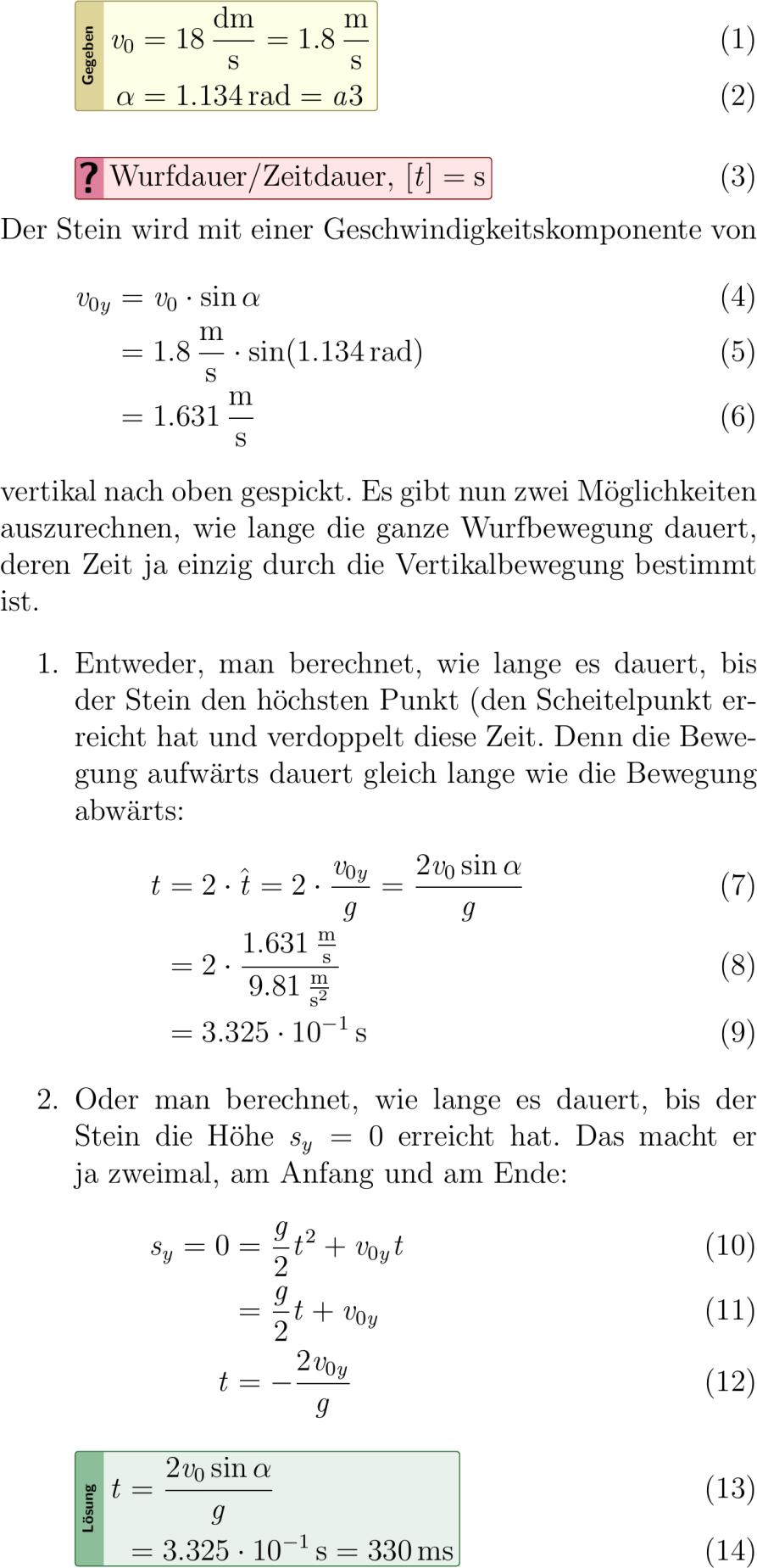
Ein Stein werde vom Boden aus mit decimeterpersecond unter einem Winkel von .rad aufwärts weggespickt. Wie lange dauert es bis er wieder auf dem Boden auftrifft?
Solution:
Geg v_ decimeterpersecond v alpha a todega GesWurfdauer/Zeitdauertsis Der Stein wird mit einer Geschwindigkeitskomponente von v_y v_ sinalpha v sina vy vertikal nach oben gespickt. Es gibt nun zwei Möglichkeiten auszurechnen wie lange die ganze Wurfbewegung dauert deren Zeit ja einzig durch die Vertikalbewegung bestimmt ist. enumerate item Entweder man berechnet wie lange es dauert bis der Stein den höchsten Punkt den Scheitelpunkt erreicht hat und verdoppelt diese Zeit. Denn die Bewegung aufwärts dauert gleich lange wie die Bewegung abwärts: t hat t fracv_yg fracv_sinalphag fracvyg t item Oder man berechnet wie lange es dauert bis der Stein die Höhe s_y erreicht hat. Das macht er ja zweimal am Anfang und am Ende: s_y fracgt^ + v_yt fracgt + v_y t -fracv_yg enumerate t fracv_sinalphag t Tect-
Ein Stein werde vom Boden aus mit decimeterpersecond unter einem Winkel von .rad aufwärts weggespickt. Wie lange dauert es bis er wieder auf dem Boden auftrifft?
Solution:
Geg v_ decimeterpersecond v alpha a todega GesWurfdauer/Zeitdauertsis Der Stein wird mit einer Geschwindigkeitskomponente von v_y v_ sinalpha v sina vy vertikal nach oben gespickt. Es gibt nun zwei Möglichkeiten auszurechnen wie lange die ganze Wurfbewegung dauert deren Zeit ja einzig durch die Vertikalbewegung bestimmt ist. enumerate item Entweder man berechnet wie lange es dauert bis der Stein den höchsten Punkt den Scheitelpunkt erreicht hat und verdoppelt diese Zeit. Denn die Bewegung aufwärts dauert gleich lange wie die Bewegung abwärts: t hat t fracv_yg fracv_sinalphag fracvyg t item Oder man berechnet wie lange es dauert bis der Stein die Höhe s_y erreicht hat. Das macht er ja zweimal am Anfang und am Ende: s_y fracgt^ + v_yt fracgt + v_y t -fracv_yg enumerate t fracv_sinalphag t Tect-
Meta Information
Exercise:
Ein Stein werde vom Boden aus mit decimeterpersecond unter einem Winkel von .rad aufwärts weggespickt. Wie lange dauert es bis er wieder auf dem Boden auftrifft?
Solution:
Geg v_ decimeterpersecond v alpha a todega GesWurfdauer/Zeitdauertsis Der Stein wird mit einer Geschwindigkeitskomponente von v_y v_ sinalpha v sina vy vertikal nach oben gespickt. Es gibt nun zwei Möglichkeiten auszurechnen wie lange die ganze Wurfbewegung dauert deren Zeit ja einzig durch die Vertikalbewegung bestimmt ist. enumerate item Entweder man berechnet wie lange es dauert bis der Stein den höchsten Punkt den Scheitelpunkt erreicht hat und verdoppelt diese Zeit. Denn die Bewegung aufwärts dauert gleich lange wie die Bewegung abwärts: t hat t fracv_yg fracv_sinalphag fracvyg t item Oder man berechnet wie lange es dauert bis der Stein die Höhe s_y erreicht hat. Das macht er ja zweimal am Anfang und am Ende: s_y fracgt^ + v_yt fracgt + v_y t -fracv_yg enumerate t fracv_sinalphag t Tect-
Ein Stein werde vom Boden aus mit decimeterpersecond unter einem Winkel von .rad aufwärts weggespickt. Wie lange dauert es bis er wieder auf dem Boden auftrifft?
Solution:
Geg v_ decimeterpersecond v alpha a todega GesWurfdauer/Zeitdauertsis Der Stein wird mit einer Geschwindigkeitskomponente von v_y v_ sinalpha v sina vy vertikal nach oben gespickt. Es gibt nun zwei Möglichkeiten auszurechnen wie lange die ganze Wurfbewegung dauert deren Zeit ja einzig durch die Vertikalbewegung bestimmt ist. enumerate item Entweder man berechnet wie lange es dauert bis der Stein den höchsten Punkt den Scheitelpunkt erreicht hat und verdoppelt diese Zeit. Denn die Bewegung aufwärts dauert gleich lange wie die Bewegung abwärts: t hat t fracv_yg fracv_sinalphag fracvyg t item Oder man berechnet wie lange es dauert bis der Stein die Höhe s_y erreicht hat. Das macht er ja zweimal am Anfang und am Ende: s_y fracgt^ + v_yt fracgt + v_y t -fracv_yg enumerate t fracv_sinalphag t Tect-
Contained in these collections
-
Schiefer Wurf auf Ebene [v0 alpha t] by TeXercises
-
| Title | Matched on |
|---|---|
| Geschwindigkeit von Projektil | tags |
| Anfangsgeschwindigkeit der Wurfbewegung | tags |
| Weite eines Balles | tagsformula |
| Höhe des Scheitelpunktes | tagsformula |
| Zeit bis Scheitelpunkt | tagsformula |
Similar exercises (27)
| Title | Matched on |
|---|---|
| Geschwindigkeit von Projektil | tags |
| Anfangsgeschwindigkeit der Wurfbewegung | tags |
| Weite eines Balles | tagsformula |
| Höhe des Scheitelpunktes | tagsformula |
| Zeit bis Scheitelpunkt | tagsformula |
| Position eines abgeschossenen Körpers | tagsformula |
| Entfernung des Scheitelpunktes | tagsformula |
| Horizontal abgeschossener Körper | tagsformula |
| Horizontal abgeschossen | formula |
| Abschusswinkel für Projektil | tags |
| Spielzeugpistole | tags |
| Geschwindigkeit im Scheitelpunkt | tags |
| Auftreffwinkel von horizontal abgeschossenem Körper | tags |
| Ballwurf von Dach | tags |
| Ballwurf von Dach | tags |
| Geschwindigkeit für bestimmte Höhe | tags |
| Neue Geschwindigkeit bei Aufwärtswurf | tags |
| Neue Geschwindigkeit bei Wurf nach oben | tags |
| Dauer des Schlüsselbund-Fluges | tags |
| Energie für Weitwurf | tags |
| Masse von Projektil | tags |
| Kurzaufgaben | tags |
| Anfangsgeschwindigkeit bei Aufwärtswurf | tags |
| Maximale Reichweite | tags |
| Maximale Reichweite allgemeiner Fall | tags |
| Aufprallgeschwindigkeit bei horizontalem Wurf | tags |
| Kurzaufgaben | tags |